False Fear

Back during my Honours thesis when I was researching about Tragedy and how it functions, I came across the concept of fear/relief as experienced by the audience. Then, when I started researching for the PhD that I never wrote, I saw the same fear-relief brought up in “Leisure Studies” (what they started calling Adult Play Psychology after it became wildly unfashionable for Play theorists to say that grown men and women would ever do anything as frivolous as “play”) in the discussion of Extreme Sports, and again in the rituals of sport. Fast forward a few years, and I find it again in books on Trauma Therapy and overcoming PTSD. I even find it in books on nutrition and adrenal-related disorders such as Adrenal Fatigue or unusual cortisol levels.

Today, in the video on High Concept films, I heard Michael Hauge talk about the promise of emotion: the emotional journey that the viewer will take, through identifying with and relating to the hero. I guess Aristotle wasn’t far off, if these concepts are still being discussed today!

So what was the common thread that I found through all these varied discussions of us humans, fear and relief? When we talk about “adrenaline junkies,” or those who love horror or thriller films or violent video games, are we talking about people who have something seriously wrong with them, who are obsessed with “danger” or violence or something else unsavory and ultimately detrimental to our society?

Well, as far as I have read and reasoned, this couldn’t be farther from the truth (besides, that video pretty much ruined my life-long love of Back to the Future).

When we watch/see/experience something that makes us feel as though there are high stakes, we get stressed. We go into “fight or flight (or freeze)” mode, a state of “high arousal” where our adrenal glands flood us with adrenaline. But rather than worrying about all the things that does on a physiological level, psychologically we become just a little more used to being in a high-stress, high-stakes situation. Now, I can imagine the short-sighted response to that. “Normalisation of bad things like violence is bad and makes us more violent!” Well, no. Normalisation of “bad things” can actually be good, provided they’re talked about. Here’s what happens: we experience something “stressful,” but are subconsciously/consciously (developmental psychologists are pretty sure that it’s conscious but willingly suppressed from the “age of reason” ie “when the child starts playing make-believe”) aware that it’s not really stressful and we’re actually safe, so we use it as a way to prepare ourselves for the real situation where we find ourselves actually in danger. Now, I don’t know how widely accepted or agreed with Peter Levine is within the world of PTSD treatment (I can imagine them thinking his methods are too “hippy”), but he points out in his book “Waking the Tiger” that the individuals least likely to suffer PTSD are the ones who feel the most empowered to respond to the situation. Neither he nor I are talking specifically about Military PTSD, but any situation where we are “powerless” (Levine quotes Freud’s description of traumatisation).

So next time you watch a scary movie, ride a rollercoaster, read a book about war crimes, indulge in the original Tales of the Brothers Grimm, play an almost-R rated FPS, or even watch the news, be aware of your play-training. Because just like a puppy play-fights, by experiencing that “false fear” and the relief that follows, you’re learning to keep your cool in a tough situation, making yourself more resilient and more trauma-proof.

Hypothetical Hiring Quandry

There is a company that, amongst other things, stores things on high shelves. One of the job positions is “High Shelf Manager.” The job description says that the person must be able to both store and retrieve items from the high shelf, which making sure that they don’t knock anything off.

The current “High Shelf Manager” has moved on to another company. Now, the HR department are on the search for the ideal candidate for the position.

In the past, this position has gone exclusively to tall people. Tall people just have a natural aptitude for putting things on high shelves, as well as retrieving them. That’s the way it’s always been. And this time, there are two tall people applying for the job, and one short person. When they go to interview the three people, they find this out: the first tall person has bad eyesight, and would have to do everything by feel; the second tall person is extremely clumsy; the short person has an awesome ladder and is very good at seeing where things are and how to get them.

Overall, the short person is the best for the job. But the HR department are concerned about the reaction of the rest of the company, especially the department that the short person will be in. Because, really, it’s a tall person’s job, isn’t it?

TV Tragedy for Today

I’ve been meaning (“struggling”) to write this post for a while, but today, between an audition for “Project Macbeth” and the season premiere of “The Biggest Loser: The Next Generation,” I think I have the ideal sweet spot.

My hypothesis, if you deign to entertain my reasoning, is that “makeover” reality TV is, functionally, today’s version of Theatrical Tragedy.

Continue reading

Book: Interactive Seduction Design by Stephen P. Andersen

Since I’m getting more interested in UX design, I thought I’d start off my self-imposed learning curve with this. I used the $30 Dymocks voucher from work to order it, and it just arrived today. I’m looking forward to reading it and giving it a review!

Remembering UX design

The other day, while working on GatD, I realised that while I had written the script with the puzzle breakdown, while I had character descriptions and an asset list, while I had a map, I hadn’t put a sliver of thought into UI design. This became REALLY apparent when I started to think about how to have the player move between rooms. Did I want context-sensitive mouse cursors throughout? What about the “look-at” function? Should they “look at and pick up” if they can? And what would the inventory look like??

Suddenly, it wasn’t just about UI – User Interface (aka GUI or HUD) – but it was about UX – User Experience.

So I’m remembering the importance of creating and maintaining a thorough GDD (Game Design Document). I guess I’d better go and work on that now!

Starting Georgia and the Dragon in AGS

So yesterday I finally sat down and got a good start on Georgia and the Dragon. I’m using Adventure Game Studio (AGS), which is software designed specifically to make graphical/point-and-click/2D (call them what you want) adventure games. I had started playing around with it a year or so ago, and had managed to put together a brief demo of The Illusionist’s Fate (a deconstructed narrative I was developing through a ScreenWest Digital Development Breakout grant) using existing art (map and some scenes inc characters).

For some reason, I couldn’t seem to manage to get myself to sit down and do work on GatD. Firstly, there was a whole stack of emotional/self-esteem/motivational issues that were getting in the way (which I might blog about later). But then, every time I opened up AGS, I couldn’t seem to find where to start. I followed my asset list and made all the Rooms, Characters, and Items, but beyond that I felt at a loss. Using the standin “Roger” player character animation that comes with AGS seemed to be the most glaringly annoying. 

I told my boyfriend, “I need to do the art first,” but he, a programmer, said that I just needed to “start coding.” Well, AGS is set up to be for “mid-level designers,” NOT programmers, and so a lot of the way it’s set up is that the behaviours are already there, you just need to put some art in, and then draw regions for hotspots and things. Everything is tied to rooms, regions, and characters. So basically, how am I meant to start if I don’t have anything to start WITH?

I thought back to Illusionist’s Fate, and how easy it was to “start” with that. That was easy because firstly I had a design doc (which I also have for GatD), and a lot of concept art. So I knew I needed art, at least a character sprite and backgrounds. Anyone who has known me for a while knows that I’m pretty capable of art. The problem is, I also have very high standards for myself. And then, Photoshop’s billions of colours got  in the way..

So I looked up some graphics programs recommended for use with AGS. I’ve downloaded Spriter to try, but am currently using Aseprite to do basic pixel-based sprite graphics. Because of the paint-style limitations, it became a lot easier to knock together a set of temporary backgrounds, which made it easier to start scripting movement between rooms.

Then, of course, the character sprite looked grossly undersized and not at all like a woman… so I cheated a little, found a gif of a female character whose proportions I liked, and painted over it and tweaked it until she looked more like Georgia. Extra points if anyone can guess her original form 😉

Image


Now, it seems like I’m spending most of my time trying to find ways to make the interaction as intuitive as possible… context-specific cursors, yes or no? 😛

Setbacks

I’ve noticed I’ve been a bit afraid to work on my game… stalling a bit. I mean, I’m always juggling my health, as well as changing jobs and moving house over the last few months, but I’ve been distracted from working on it like I wish I was driven to do.

So I’ve been trying to really understand myself, really get a feel of what I want to be doing (and whether it fits) and figure out why it might not be on the top of my list.

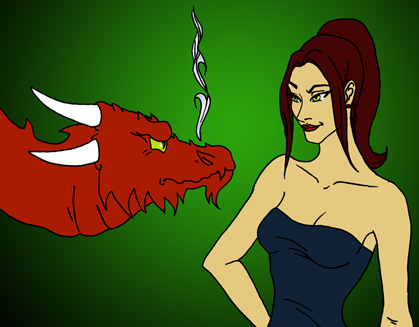
Georgia&Dragon-smaller.jpgThe conclusion that I’ve reached is that I really want to play to my strengths, I really want to do a good job, and I’m scared that either I won’t be proud of this, or I will be making something of a cop-out. In other words, the idea is there, but the vision isn’t. I want to make something “me,” but of course the self is an always-changing concept, especially when going through life changes such as illness (or healing), job search/changes, or moving house. So now, I’m fairly settled, I feel well, and happier that I have been for a long time. I’ve had some moments of clarity, and I’m hoping to get a lot of work done. Hopefully you can all see something very soon!